Early September of this year I was talking with Matthew Fralin, owner of Quarter Minute Arms, when the topic of integrated full-length ARCA rails came up. For those who know me well, they know that I absolutely like this style of rail. A quick glimpse into BRDGW history here. The rifle that brought BRD into the predator hunting community was my 6 ARC PRS rifle that had a Sgt of Arms 17.5” rail with an integrated full-length ARCA rail. These rails are now made by Jeff, the owner of MTE Machining.
Long story short, Matthew asked me if I’d like to try a new rail made by Spikes Tactical that he had recently picked up to try himself. Sure thing. I spent a little over three months using this rail on the bench and in the field coyote hunting. Here’s my experiences and thoughts.

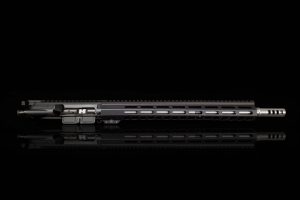
Product image from Spikes Tactical website
Pros:
Lightweight
Integrated full-length ARCA rail with R-Lock
Bar style barrel nut
Integrated anti-rotation tabs
M-LOK slots at 3, 6, and 9 o’clock positions
DPMS high rail only
Cons:
Lightweight
Outside diameter size
The barrel nut
Integrated anti-rotation tabs
DPMS high rail only
“Built in” QD sling cup attachments
Proprietary barrel nut wrench required- Sold separate from the rail
Initial thoughts
Upon receiving the Spikes Tactical ARCA CRR M-LOK .308 rail, I was surprised at how skeletonized it was, but yet retained plenty of material in the area of the integrated ARCA rail. I will admit. I was a bit skeptical of how rigid the rail would be. The rail is the standard 6061-T6 aluminum.

It was nice to see the R-Lock in the ARCA rail. While I, and most predator hunters, don’t use a ball head with the R-Lock system, having the R-Lock in the rail makes it more universal.

I was disappointed in the requirement of a proprietary barrel nut wrench. They’re not the only company that does this, but their wrench is an additional $53.00 on top of the purchase of the rail.
From a builder’s standpoint, I dislike the barrel nut. When I looked at it, and I saw the bag of shims, I knew that it would not allow me the precise torque adjustment that I prefer for BRD rifles. More on this later. The barrel nut is made from 7075-T6 aluminum and looks to be very similar to a Bar nut. As I don’t have any large frame AR rifles utilizing the Bar, nut, I can’t explicitly say that they are interchangeable.
Aesthetics. This can be very personal but can have an effect on operational or performance characteristics if designed poorly. While I don’t see any of the latter, except maybe for the QD cups, I can say that the visual appeal of the rail is not there for me. I will add that the rail does have some “sharp” areas on it. I do not grasp the rail when shooting off of a tripod, so I didn’t experience any negatives from this. If you are one who may grasp the rail when shooting off of a tripod, a barricade, etc., or if you transport your rifle laying on a seat as I know that some do, you may find this to be problematic at times.
Installation
This rail was installed and removed a decent bit as I changed up the barrel configuration three different times. The upper started as a 243, then went to a 22 Creedmoor, and I finally settled on a 6 Creedmoor.
In the Pros and Cons I listed the DPMS high rail in both categories. Here is the reason. The DPMS high profile rail is the most common large frame platform for upper receivers. That said, BRDGW rifles currently use DPMS low profile rails. So, I didn’t have an upper on hand that it would fit. Also, the most popular non-reciprocating large frame upper receiver on the market is a DPMS low profile. Meaning that this Spikes rail is incompatible with it.
I also listed the integrated anti-rotation tabs in the Pros and Cons. It took me three upper receivers before I found one that would fit the anti-rotation tabs. Being that this wasn’t my personal rail, I was not going to modify the anti-rotation tabs to fit the other upper receivers. Which is something that you can most likely do should you run into this.
Why I despise the barrel nut. I am OCD on the barrel nut torque for BRD rifles. The barrel nut for this Spikes Tactical rail only provides you with four possible mounting solutions using shims to achieve the gas tube alignment position. I went through a lot of shims being that I installed 3 different barrels. It’d be nice if Spikes would include at least 4 more gas tube slots and corresponding holes for the rail mounting screws. Adding more alignment locations would aid in achieving a more precise torque value, but if enough locations were added, then the shims could be done away with. Granted all of this comes with added machining time and costs. I’d gladly take that additional cost for what would make this a better product. A little good about the barrel nut is that it is a Bar style nut. This aids in adding rigidity at the upper receiver extension. Albeit at the cost of a larger diameter rail, which is to be expected in an integrated ARCA rail handguard. As many times as I had the handguard retaining screws in and out of the barrel nut, the screw holes and screws held up great. This is a weak area that I’ve seen in other similar rails. Either the screw heads or the screw holes begin to strip out.
Aside from the above, installation of the handguard was as simple as most standard handguards on the market.
Test Lower
At first, I threw together a test lower with components that I had laying around. Most of which are components found in the BRDGW Pro series of rifles. Except for the stock and the trigger.
I listed the light weight of the rail as both a pro and a con. This is due to the overall balance of the rifle. Most people don’t think of this as being a thing when shooting off of a tripod, but it is. Granted, we can influence the balance point of a rifle more on a tripod depending on where we lock the ARCA rail in the head. This can provide us with different handling characteristics. I originally put a Magpul PRS Gen 3 stock on the test lower. I’m not a fan of this stock for a few reasons, but it actually balanced well with the different barrels and the skeletonized Spikes handguard. The balance point with the 243 barrel was right on the front lip of the magazine well. Generally, I prefer the balance point to be a little front heavy to neutral, and this was close. The 22 Creedmoor and 6 Creedmoor barrels are a different profile and provide for a different balance point.
I ended up removing the Gen 3 PRS stock and installing my preferred B5 Precision stock. This also provided a better balance point with both of the Creedmoor barrels. While I was at it, I removed the trigger and replaced it with my preferred Triggertech Diamond trigger.

Range Time
While shooting groups and testing at the range, I did a couple of informal rigidity tests. I was pleasantly surprised at the amount of deflection that I saw when bottom loading the handguard. It wasn’t as much as I figured it would be. That said, if I was to use a clip-on thermal, there is a possibility that I could see some discrepancies between it and the optic under some what I would call above average loading of the handguard.
I shot some groups with all three of the barrels. With the 243 I shot factory 58g and 75g Superformance ammunition. In the 22 Creedmoor I shot the 69g TMK handload that I had been using to coyote hunt with. For the 6 Creedmoor, factory 87g Hornady ammunition it was. I didn’t see much of a change in groups between the Spikes handguard and the BRDGW rifles that these barrels had been in. Nothing that I can confidently say is this or that.
Field Testing- Coyote Hunting
Now for the fun part. Getting to put fur down. As I previously stated, I settled on running the 6 Creedmoor barrel. All of the hunting was done at night and off of a tripod. As much as I like to day hunt coyotes, time is a thing, and that isn’t how most people are hunting them at the current time. And, for what it’s worth. For the last few years when I do day hunt, I hunt off of a tripod. Not a bipod. The farthest coyote that I can recall killing and putting hands on was a little over 300yds when using this handguard. So, not far at all.

As far as the actual performance of the rail goes in the field. I don’t have much to say about it. I did not have any real negative experiences with it in the field. To be fair, I do not attach a lot of items to my handguards. Just a laser module for marking downed coyotes when needed in thick grass or woody areas. I did not use a bipod, or mount one, but I know there are guys that do at night. I also didn’t utilize the QD cups as I do not use a sling when hunting at night. More on this in the final thoughts later.
Over the many hunts that I used this on; there were a couple of times that I bit the dust while walking in. Once while walking a ditch line and the ground gave way, dropping me about 6 feet down. The other while walking in hardened crusted snow, until it wasn’t anymore, dropping me about a foot causing me to lose my balance. Neither time produced any negative effects to the handguard or rifle. There were some times when walking in tall grass or wooded field edges with low hanging trees, that something would get caught in one of the many openings of the handguard. Something that I generally don’t experience with other handguards as the items just brush along the rail due to less possible snag points.
I use Fatboy tripods and Invert60 ballheads. All of my personal rifles have a 5” Fatboy ARCA rail on them. I did have to loosen the tension just a bit on my ballheads to allow for proper camming of the ballhead lock with the Spikes handguard. When I walk into a stand, I walk in with the rifle locked into the tripod. I had no negative experiences doing this with the Spikes handguard. No slippage. The rail was always tight in the ballhead.
As you can see by the wear marks in the pictures, I didn’t use much of the ARCA rail when mounting it to my tripod. The majority of the time I was within the first few inches. There were a few times that I mounted further out to provide for more rearward weight bias, but this is not a common practice for me. Something that I did notice at times, is that when I would change the location on the ARCA rail, that I’d have to change the tension a bit on my cam lock for the ballhead. I’m going to make an assumption here that is most likely due to the coating wearing off of the rail through use. As I’ve had this happen with numerous other brands of ARCA rails, too. I will admit. I did not take a micrometer or calipers to the rail and begin to measure locations on the rail to check for machining tolerances.


This rail with the profile of my barrels, balanced out nicely. For the majority of my hunts, I stayed on the rifle scanning. With the balance, I was not being worn down. I was not fighting the rifle. It balanced well in the ballhead. The rifle reacted quickly and positively. Again, I like a neutral to slightly front heavy rifle.


Final Thoughts
This rail is not for me. That doesn’t mean that it might not be for you.
One of the big negatives for me is the size of the rail. It is 18” long and is a nice length for the 20” and 22” barrels that I used. It’s the diameter. The outside width of the rail that I used measured 1.898” and the outside height measured 2.350”. In other words big. This provided me troubles. Not while in the field, but during the transition times between stands. It was too big to fit in the racks of the primary hunting trucks. I really had to wedge it in the holder of the rack, and sometimes I would spend minutes doing this. Sometimes I could get a retention strap around it and other times I couldn’t. When I could, it wasn’t uncommon for it to come off and fly to the front hitting one of us. Lol. If you are the person that lays your rifle on the seat, beware that this rail does have some shard edges to it. It could cause damage to the seat material. If you use a gun case between stands or have a rack made that your rifle lays in during transport, then this is of no concern to you.
The weight. It is light. If you use a smaller profile barrel and care about the balance of a rifle, then you may find some concerns with this. If you’re looking for absolute weight reduction, then this may be for you.
I weighed the complete upper that I was using. With the 20” 6 Creedmoor barrel, JP low mass carrier, SLR melanite adjustable gas block, and a rear charge upper receiver with a Radian Raptor charging handle, the weight was 6lbs 6.9oz. That’s with no suppressor. I weighed the Spikes rail with barrel nut and screws and it tipped the scale at 1lb 2.3oz. This is considerably lighter than other handguards with integrated ARCA.
To put the above in perspective, I weighed a 16” large frame AR rail that is used on BRDGW rifles. The rail with barrel nut, attaching hardware and a Fatboy 5” ARCA rail. It tipped the scale at 1lb 0.3oz. Being that I will not utilize the last 13” of the Spikes handguard, the integrated ACRA rail becomes less of a factor as I require the smaller diameter rail and I have all of the ARCA rail that I will use.
The “built in” QD cups that are not built in. They are attached by two very small screws. As previously stated, I did not use the QD cups. I do have concerns, though. Might be valid. Might not be. Just take it for what it’s worth. More guys are using slings in combination with a tripod. This is why all BRDGW rifles have a QD cup in the end plate and a true built in QD cup in the rail. Some guys are packing in tripods and slinging rifles, while others are using a sling to add tension to the shooting system when clipped into the tripod. A method that has been around a while in the military and LE communities. Both of which provide added stress to the QD cups. My concern would be a cup coming loose due to screws coming loose. Just something to think about.


For the average nighttime predator hunter who wants an integrated ARCA rail while saving weight, and the diameter of the rail doesn’t affect you, then this could be for you. Check it out. If you’re a day and nighttime hunter, or a nighttime hunter who runs a bipod on your rifle in addition to the tripod, maybe do some more research and see what you can find on long term testing of this rail. Will it have enough rigidity to do well for your hunting style. Maybe you want your rifle to be a multi-role rifle for some long-range shooting/ competition and hunting. I would also research this rail further. My personal preference would be to go with a heavier handguard for long-range shooting and competition.
This was not meant to be an in-depth review. I only had it short term. It’s meant to provide insight on a rail that some people may find interesting to use on their predator hunting rifles. If you have used, or are using this rail, please leave some comments with your experiences. If you are looking at an integrated ARCA rail handguard, I highly recommend that you also consider one from MTE Machining. These are great handguards.